Table Saw vs Miter Saw: What Each One Does Best (October 2026)
A table saw rips boards along their length, and a miter saw makes crosscuts and angled cuts across them. Most people buy the saw that matches the cut they make most often, and many shops eventually keep both.
On this page (15 sections)
- Table saw vs miter saw: where each one cuts
- Ripping on a table saw and crosscutting on a miter saw
- Width and capacity compared
- Angles and bevels
- Setup and space
- Accuracy and repeat cuts
- Safety differences
- Which one should you buy first?
- Trim, molding and frames
- Crosscutting lumber to length
- Blade size and blade types
- Stops, stands and the space they need
- Setup mistakes to avoid with each saw
- The two saws side by side
- Table saw or miter saw: the short answer
A table saw and a miter saw both cut wood, but they cut in different directions. A table saw rips boards along their length, and a miter saw makes crosscuts and angled cuts across them.
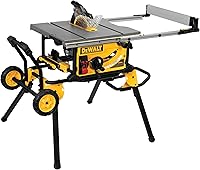
This page compares the two on the cuts they make, width and capacity, space, safety and which one to buy first. The table saw is a DEWALT DWE7485, and the miter saw is a DEWALT DWS715.
 Best for a small shop that still rips sheets
DEWALT DWE7485 8-1/4 Inch Compact Table Saw

Table saw vs miter saw: where each one cuts
A table saw cuts along the length of a board, with the grain, and the fence guides the wood past the blade. A miter saw cuts across the board, and its blade drops down onto the wood.
That's the main split. If your cuts run the long way on a board, a table saw does the job.
If your cuts run across the board or at an angle, a miter saw is usually the faster tool.
Ripping on a table saw and crosscutting on a miter saw
Ripping is the table saw's main job. You set the rip fence to the width you want, then feed the board along it past the blade with the push tools your manual calls for.
Crosscutting is the miter saw's main job. The blade drops across the board at the angle you set, and a stop or a fence holds the board square.
Ripping boards on a table saw
The DWE7485 has a 24.5 inch rip capacity. That's the distance from the blade to the fence, so it sets how wide a board you can rip in one pass.
A table saw can crosscut too, with a miter gauge or a sled. It's slower to set up for that job than a miter saw, and it takes more care.
Crosscuts and miter cuts on a miter saw
The DWS715 crosscuts 2x8 lumber at 90 degrees and 2x6 lumber at 45 degrees, based on DeWalt's stated capacities. Its bevel tilts left to 48 degrees and right to 3 degrees, and its 14 positive stops make repeat angles quicker to set.
The 2x8 figure sets the reach of this saw. Check the capacity against the widest board you plan to cut before you buy.
Width and capacity compared
A miter saw's capacity is about the width and height of the board it can cross. A table saw's capacity is about how far it can rip, which is the distance from the blade to the fence.
Both numbers matter. Measure the widest board you cut and the widest rip you need before you choose a saw.
The DWS715's 2x8 capacity at 90 degrees is the limit to check. A 2x10 or 2x12 board is past that capacity, so those boards need a different tool or a different cutting method.
Angles and bevels
A table saw tilts its blade for bevel cuts, which give an angled edge along the board. That's useful for a tabletop edge or a shelf.
A miter saw sets its miter and bevel angles on the saw head. That's why it suits trim, frames and molding, where the angle is the whole point of the cut.
Setup and space
A miter saw sits on a stand or a bench, and the DWS715 weighs about 43 pounds. A table saw needs a flat, level spot, and the DWE7485 weighs about 54 pounds.
Both saws need room around them. Plan the space for the longest board you cut, not just for the saw itself.
The table saw needs room for the board to pass the blade and clear the outfeed side. The miter saw needs room on both sides of the blade for the board to rest.
Accuracy and repeat cuts
Both saws can repeat a cut accurately when the setup is right. A table saw's fence holds the rip, and a miter saw's stops hold the angle.
Accuracy depends on setup more than on the type of saw. Check a stop or a fence against a square before you rely on it.
Check the fence on the table saw and the stops on the miter saw before you start a batch of boards.
Safety differences
Both saws can cause serious injury, and each has its own rules in the manual. Keep your hands clear of the blade's path on either one.
On a miter saw, let the blade stop before you lift it, and keep your hands clear of the blade's path when you lower it. On a table saw, use a push stick for narrow pieces and keep your hands back from the blade, as table saw kickback explains.
Which one should you buy first?
Buy the saw that matches the cut you make most. If you rip boards and build cabinets or furniture, start with a table saw.
If you cut trim, framing and angles, start with a miter saw.
Many home shops end up with both, but you don't need both on day one. If the bench space is tight, check best portable table saws for a saw that folds away, and table saw stands for a stand that suits the work.
Trim, molding and frames
A miter saw is the better tool for trim and molding, because its miter and bevel angles are set on the saw head. Trim depends on accurate angles at the ends, and a miter saw holds those angles with positive stops.
A table saw can make angled cuts with a sled, but the setup takes longer for every change of angle. For frames and molding, the miter saw is the faster tool.
Crosscutting lumber to length
Both saws crosscut boards, but a miter saw is faster when you cut the same length many times. A stop on the saw holds the board length, so each cut repeats without remeasuring.
A table saw with a sled does the same job, but the sled takes more setup. For a run of identical lengths, the miter saw is the more practical choice.
Blade size and blade types
The DWS715 uses a 12-inch blade, and the DWE7485 uses an 8-1/4 inch blade. The two saws can't share blades, so buy each one by its size.
Crosscut blades usually have more teeth than rip blades, and that difference matters on both saws. The best table saw blades roundup covers the table saw side of the choice.
Stops, stands and the space they need
The DWS715 has 14 positive stops, which give repeat angles without reading a scale each time. Check that a stop lands on the angle you want before you cut a batch.
Both saws need a stable stand or bench. The table saw stand guide covers stands that suit portable saws, and a miter saw needs one too.
Setup mistakes to avoid with each saw
The easiest setup mistakes to miss are an unchecked fence on the table saw and an unchecked stop on the miter saw. Check both before a batch of cuts.
On the miter saw, let the blade stop before you lift it. On the table saw, keep the guard and riving knife set up as the manual directs.
Don't expect a miter saw to rip a long board, and don't expect a table saw to cut trim angles as cleanly as a miter saw does. Pick the tool for the cut, and the job gets simpler.
If you have to choose one first, use the cuts in your next three or four projects as the test.
The two saws side by side
Here are the table saw and the miter saw from this comparison, with the features and specs that matter most for the choice.
| Product | Best for | Blade size | Motor | Main cut | Our score |
|---|---|---|---|---|---|
| DEWALT DWE7485 8-1/4 Inch Compact Table Saw | a small shop that still rips sheets | 8-1/4 in | 15 amp | 24.5 in rip capacity | 8.1 |
| DEWALT DWS715 12-Inch Miter Saw | square and angled crosscuts | 12 in | 15 amp | 2x8 crosscut at 90 degrees | 8.0 |
The DWE7485 is the table saw in this pair, and the DWS715 is the miter saw. Each badge names the cut that saw handles best.
Table saw or miter saw: the short answer
Pick a table saw for rips along the length of a board, and pick a miter saw for crosscuts and angles across it. The cut you make most is the one that should decide.
If you're also weighing a circular saw, table saw vs circular saw covers the handheld option that goes to the wood.
Frequently asked questions
Can a table saw do the job of a miter saw?
Partly, since a table saw can crosscut with a miter gauge or a sled, but a miter saw is faster and built for angle cuts. Check the manual before you make any crosscut on a table saw.
Is a miter saw better than a table saw for trim?
For trim and molding, a miter saw is usually the easier tool, because its bevel and miter angles are set on the saw head. A table saw is better for rips, such as cutting a board to width before it becomes trim.
Which should a beginner buy first?
Buy the saw that matches the cut you'll make most, so rip-heavy work points to a table saw. Trim, framing and angle work points to a miter saw.