Table Saw vs Circular Saw: Which Do You Need? (October 2026)
A table saw gives repeatable rips and square cuts at one bench, while a circular saw goes to the wood, so it wins for cuts made on site or on the floor. Pick the saw that matches where most of your cuts happen.
On this page (12 sections)
- Table saw vs circular saw: where the blade sits
- Which one gives more accurate cuts
- How big a cut each one can make
- Setup, space and moving the saw
- Safety differences you should know
- Which one should you buy first?
- Learning curve and setup time
- Blades don't swap between the two saws
- Cut quality and tear-out
- What each saw does poorly
- The two saws side by side
- Choosing between a table saw and a circular saw
A table saw and a circular saw both spin a blade to cut wood, but they work from opposite ends of the job. A table saw keeps the blade fixed and brings the wood to it.
A circular saw stays in your hands and goes to the wood.
This page compares the two on accuracy, cut size, space, safety and which one to buy first. It's written for a home workshop, not a commercial one.
 Best for repeat rips at one bench
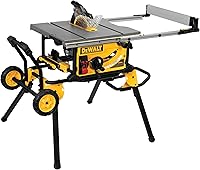
SKIL TS6307-00 10-Inch Jobsite Table Saw

Table saw vs circular saw: where the blade sits
On a table saw, the blade stays in one place and the wood moves across it. On a circular saw, the blade moves through the wood, and you guide the saw along a line.
That one difference shapes most of the trade-offs in this comparison, from accuracy to where you can work. Once you know where the blade sits, the rest of the choice gets easier.
Which one gives more accurate cuts
A table saw is the better choice when many boards need the same width. A rip fence locks at a set distance, so each board runs past the blade at the same distance while the fence stays locked.
A circular saw can make accurate cuts too, but accuracy depends on a straightedge, a guide or a careful line. Two cuts from the same mark can come out a little different, especially on a long board.
Table saw and circular saw for repeat cuts
Set the fence once and check the setting with a tape before the first cut. After that, each board runs past the blade at the same distance, which is the table saw's main strength.
The circular saw wins when the cut is one-off or too long for a bench. Repeat work on a circular saw takes more setup and more checking.
How big a cut each one can make
A circular saw handles long or wide material you can't carry to a bench. A table saw handles rips up to its rip capacity, on a fixed bench.
The SKIL TS6307-00 has a 25-1/2 inch rip capacity. That's the distance from the blade to the far side of the fence, so it sets how wide a board you can rip in one pass.
The DEWALT DWE575 cuts to a depth of about 2-9/16 inches at 90 degrees. Thick stock is past its reach in one pass, so check that depth number before you buy.
Sheet goods and 4x8 plywood
A full 4x8 sheet is heavy and awkward on a portable table saw. Plan support on both ends before you try to cut one, and make sure the cut fits the rip capacity.
A circular saw can cut a sheet on the floor or across sawhorses, with a straightedge to guide it. The manual shows how to support the sheet and set the blade depth, and the method avoids lifting a full sheet onto a saw.
Setup, space and moving the saw
A circular saw is easy to carry, and it fits in a bag. A table saw needs a flat, level spot, and a portable one still needs a stand or a bench to be useful.
Portable jobsite saws give some of that portability back. The folding stand on the SKIL and the rolling stand on other models help, but they still weigh far more than a handheld saw.
Safety differences you should know
Both saws can cause serious injury, and each has its own kickback and guard rules, so the manual comes first on either one. A careful setup matters more than the type of saw.
On a table saw, the wood moves across the blade, and kickback is when the board is thrown back toward you. Table saw kickback covers what the manual says about it, and what to avoid.
On a circular saw, the blade sits under the base plate, and the lower guard should move freely and cover the blade. Check the guard before each cut, as the manual directs.
For either saw, wear eye and ear protection, and keep your hands clear of the blade's path.
Which one should you buy first?
Buy a table saw first if most of your cuts happen at one bench. Buy a circular saw first if most of your cuts happen where the wood is.
Pick a table saw if you rip a lot of boards to a set width, build furniture or cabinets, and have a fixed spot with room for a stand. The SKIL and the DEWALT DWE7485 in this comparison both suit that kind of shop.
Pick a circular saw if you cut framing or decking on site, work in tight spaces, or need one tool that goes anywhere. The DEWALT DWE575 suits that kind of work.
Plenty of home shops end up with both. You don't need both on day one, and the first saw should match the work you already plan to do.
Learning curve and setup time
A circular saw is quick to start, but a table saw asks for more setup once, and that setup pays off on repeat work.
On a circular saw, most of the setup is the guide and the mark. You check the line, set the depth and clamp the guide, and the cut itself needs little adjustment.
A table saw asks for more up front. You square the blade, set the fence and check the guard, and then each rip repeats the same setting.
Test the setup on scrap wood before you cut the real board. Follow the manual for the setup steps on either saw.
Blades don't swap between the two saws
A table saw and a circular saw use different blade sizes, so a blade for one won't fit the other. The SKIL is a 10-inch table saw, and the DEWALT DWE575 takes a 7-1/4 inch blade.
Blade type matters on a table saw as much as size. A rip blade and a crosscut blade cut differently, and the best table saw blades roundup compares the options for home woodworking.
For the blade swap itself, how to change a table saw blade follows the general steps. Check the manual for your saw first.
Cut quality and tear-out
Clean edges depend more on the blade and the material than on the type of saw. A sharp blade with the right tooth count gives a cleaner edge on either tool.
Tear-out is the splintering at the edge of a cut, and it shows up most on plywood and laminates. Test the setup on scrap before you cut the real board.
A table saw's fence keeps the edge straight along a long rip. A circular saw depends on the guide and the blade staying on the line, so a small drift in the guide shows up on the edge.
What each saw does poorly
A table saw struggles with full sheets, since the sheet has to travel across the blade with support at both ends. Long boards also need an outfeed plan, which takes space.
A circular saw is a poor choice for a run of identical boards, since each cut depends on the guide and the mark. If a miter saw is also on your list, table saw vs miter saw covers the crosscut side of the choice.
The two saws side by side
Here are the two saws from this comparison, with the features and specs that matter most for the choice.
| Product | Best for | Blade size | Motor | Main cut | Our score |
|---|---|---|---|---|---|
| SKIL TS6307-00 10-Inch Jobsite Table Saw | repeat rips at one bench | 10 in | 15 amp | 25-1/2 in rip capacity | 8.4 |
| DEWALT DWE575 7-1/4-Inch Circular Saw | cuts made on site | 7-1/4 in | 15 amp | 2-9/16 in depth at 90 degrees | 7.7 |
The SKIL is the table saw in this pair, and the DEWALT DWE575 is the circular saw. Each one's badge names the kind of work it suits best.
Choosing between a table saw and a circular saw
Choosing between a table saw and a circular saw comes down to where your cuts happen. A table saw gives repeatable rips at a bench, and a circular saw takes the cut to the wood.
If you're still unsure, read what a table saw is before you decide. If a third option is on the list, table saw vs track saw covers the track saw, which sits between the two.
Frequently asked questions
Is a table saw more accurate than a circular saw?
For repeat rips at one bench, a table saw is usually easier to keep accurate, because the fence locks at a set width. A circular saw can be accurate too, but it depends on a good guide, a steady line and a clean first cut.
Can a circular saw replace a table saw?
For some jobs, yes. A circular saw can cut sheets and framing, but it can't match a table saw for repeat rips at one setting, and it won't give you a fence or a stable table to work from.
Which should a beginner buy first?
A beginner who builds furniture or cabinets often starts with a table saw, and one who works on site often starts with a circular saw. Match the first saw to the cuts you make most, and check the manual before the first cut either way.