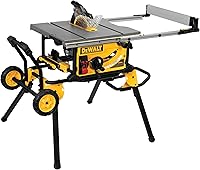
Are Portable Table Saws Worth It for a Home Shop?
Yes, for a home shop that rips sheet goods and boards and needs to move the saw between spots. A portable table saw is the wrong pick if you mostly cut short stock or need a saw for daily production work.
On this page (8 sections)
Are portable table saws worth it? For a home shop that rips boards and sheet goods, yes.
A portable table saw packs a full-size blade and a rip fence into a body you can move, which matters when the space has to work for other jobs too.
The trade-offs are real, though. You get a smaller table, less stability than a heavy saw and a shorter list of cuts it does well.
What a portable table saw gives a home shop
A portable table saw gives you a rip fence and a blade that cuts through hardwood and sheet goods. Those are the cuts a table saw does best, and a circular saw can't match them on a long, straight rip.
It also folds, rolls or sits on a stand, so it can live in a garage that you use for other things. You can store it when you're done and set it up again for the next job.
Where a portable table saw falls short
The table is smaller than a cabinet saw's, so long boards need support on both sides. A roller stand or outfeed table covers that need, and the outfeed guide explains when you need one.
A portable saw also weighs less than a heavy saw, so it can move on a bench. That makes it easy to move, and it also means it can shift under hard work if it isn't set up well.
Most portable saws have a smaller motor than a cabinet saw. For home projects that's rarely a problem, but for heavy production runs it can slow you down.
Who should buy a portable table saw
A portable table saw suits a homeowner who rips boards and plywood now and then. It also suits anyone with a garage, basement or spare room that needs to hold a saw for a few days and store it the rest of the time.
It's a good match for a shop with limited floor space. A portable saw sits on a bench or stand, and it folds out of the way.
If you want a first table saw for building shelves, trim or simple furniture, a portable model covers most of the work.
Is a portable table saw worth it for a home shop?
For most home shops, yes. A portable saw gives you the rip capacity and fence that a circular saw can't, at a size a garage or basement can hold.
If your shop has room for a bigger saw and you cut all day, a heavier saw may hold up better. It's worth weighing that against the space and cost before you decide.
Who should skip a portable table saw
Skip it if you mostly cut short stock, like trim pieces or small blocks. A miter saw handles short crosscuts with less setup, and it's often the better tool for that job.
Skip it if you need a saw for daily production work. A portable saw is built for home projects, and a heavier saw suits steady use better.
Also check the manual before you plan a dado set. Not every portable saw takes one, and the manual says what arbor and blade it needs.
Budget, mid-range or premium
Entry, mid-range and premium saws differ most in stand design, rip capacity and motor size. A budget saw can do good work on simple projects, but it usually has a shorter rip capacity and fewer extras.
Mid-range saws often add a rolling or folding stand, a larger rip capacity and a riving knife in the box. Premium saws add a heavier build and a more solid stand, and they cost more to buy and move.
Whatever the tier, look for a blade guard, a riving knife and anti-kickback pawls in the box.
Match the saw to the projects you plan. A saw that can't rip your sheet goods is a poor buy, even if it's cheap.
Three portable saws to compare
Each of these saws suits a home shop, but for different reasons. Read the specs against your space before you pick.
Safety before you buy or cut
Read the maker's manual before the first cut, and keep the blade guard, riving knife and anti-kickback pawls in place. Kickback is the risk to plan around, and the manual explains how to avoid it.
Use push sticks for narrow cuts, and never reach over a spinning blade. Keep your hands clear of the blade path, and unplug the saw before you change a blade.
If the saw doesn't seem stable, stop and fix the stand before you cut. Safe use starts with the setup, and the maker's manual is the final word on how to set it.
So, are portable table saws worth it?
Yes, for a home shop that rips boards and sheet goods, if you follow the manual and keep the guards on. For short cuts only, a miter saw or circular saw may fit better.
Start with the choosing a table saw guide to match a saw type to your shop, then compare the best portable table saws for the models that fit. For the whole picture, the portable table saw guide covers stands, blades and safe use.
Frequently asked questions
Are portable table saws worth it?
Yes, for a home shop that rips boards or sheet goods and needs the saw to move between spots. They're a weaker pick for short cuts only, or for daily production work where a heavier saw holds up better.
Can a portable table saw do the same work as a cabinet saw?
Not quite, since a portable saw has a smaller table, a lighter body and usually a smaller motor. It suits home projects better than heavy production runs, so check the maker's manual for the cuts it's rated for.
Is a portable table saw safe for a beginner?
Any table saw can cause serious injury, so a beginner should start with the manual. Keep the guard, riving knife and anti-kickback pawls in place, use push sticks as the manual shows, and learn the setup before you cut long stock.
What's the difference between a portable table saw and a jobsite saw?
The two names often mean the same thing. Jobsite saws are usually portable saws with a stand or folding legs, so check the stand and weight before you buy.